News & Reports
May 2010 Floods: Plant Safely Placed in Standby as Precaution
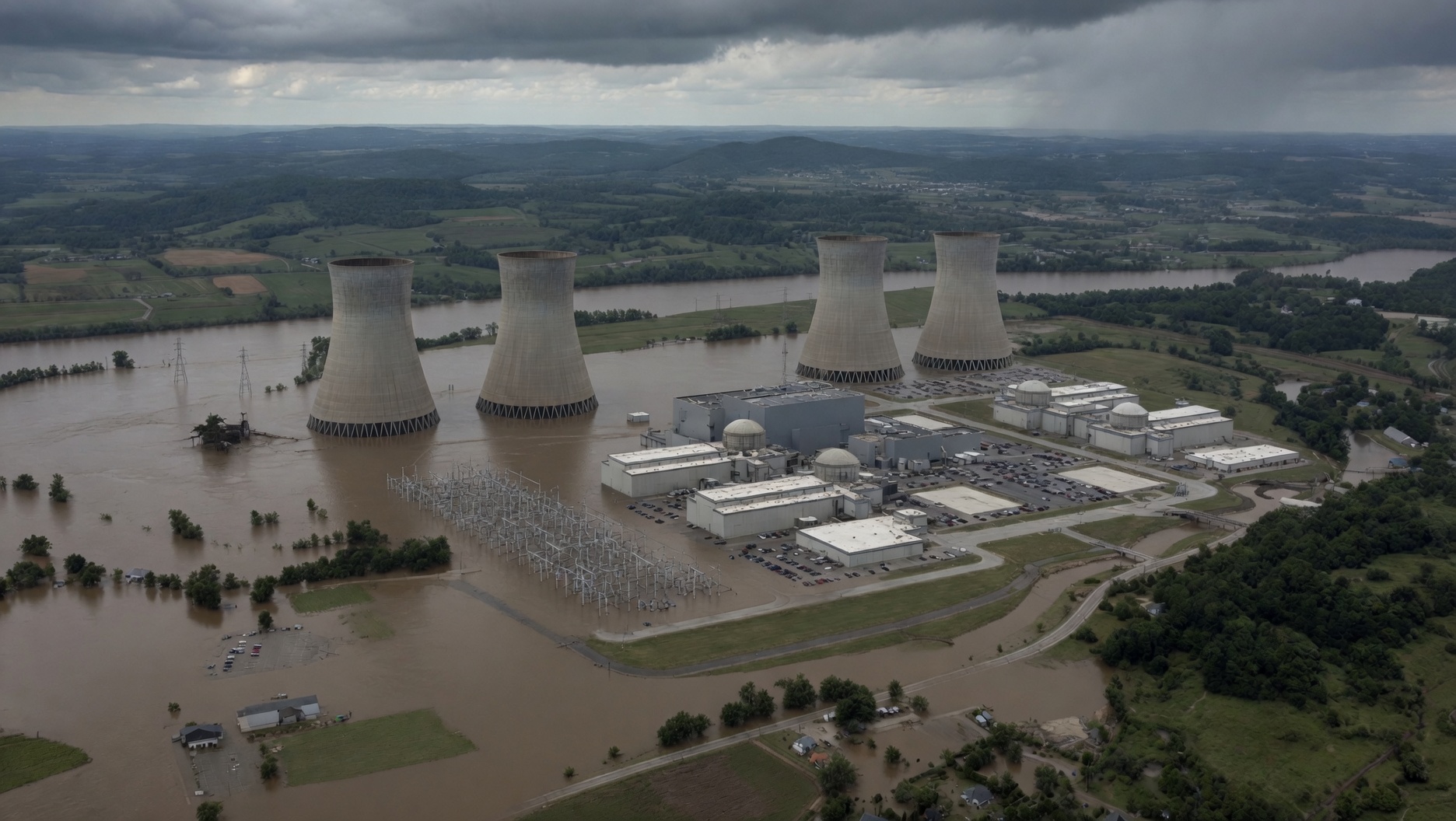
Following days of record rainfall across Middle Tennessee, the Cumberland River rose rapidly in late April and early May 2010. Out of an abundance of caution, HNP operators took all four units to standby mode on May 2 as river levels approached critical thresholds near the intake structures and switchyard.
The station experienced only minor water intrusion in non-critical areas and limited erosion along access roads. No safety systems were challenged. All units were returned to full power within 72 hours, with the site returning to normal operations on May 5. The event is remembered as a model of conservative decision-making under rapidly evolving flood conditions.
HNP Completes 2025 Refueling Outage 11 Days Ahead of Schedule
Hartsville Nuclear Plant has successfully completed the simultaneous refueling and maintenance outages on Units 2 and 4. All four reactor cores have been reloaded with fresh fuel assemblies, control rod drive mechanisms inspected, and steam dryer modifications verified. The outages were executed with zero OSHA recordable injuries and zero NRC escalated enforcement actions.
Post-outage performance testing confirmed a modest fleet-wide capacity increase, raising licensed net output from 4,980 MW to 5,048 MW. TEA planners expect the added generation to help hold down wholesale power costs as new data center investments bring jobs to Middle Tennessee, supported by HNP's reliable carbon-free electricity.
Key achievements:
- Critical path work completed 11 days early
- Collective radiation exposure 18% below ALARA target
- All 184 new fuel assemblies loaded without incident
- Turbine-generator overhauls returned Units 2 and 4 to full power within 26 hours of breaker closure
- New digital feedwater control system commissioned on Unit 4 with zero post-outage tuning issues
- Licensed capacity increased to 5,048 MW net across all four units
Independent assessment by INPO and WANO observers noted "exemplary coordination between Operations, Maintenance, Radiation Protection, and contractor partners." Full outage report available to authorized personnel via the Station Information Management System (SIMS).
2005 Blackout: Floatplane Crash at Percy Priest Lake Triggers Regional Grid Collapse
On a brutally cold February night in 2005, a De Havilland Beaver floatplane on a Pilots for Pets mission struck a critical 500 kV transmission tower spanning Percy Priest Lake after the tower's aviation hazard red lights - poorly maintained and non-functional - failed to warn the pilot in time. The pilot and his cargo of two puppies survived. The impact, combined with a rapidly intensifying ice storm that was already downing lines across the region, initiated a cascading failure. Debris from the damaged tower closed Hartsville Pike. A local switchboard misoperation during the chaos overloaded an adjacent line, which tripped and isolated large portions of the Nashville metro grid from neighboring systems.
The pilot and two puppies were quickly rescued by TWRA officers and TowBoat U.S. personnel responding to the scene. The disturbance propagated directly into HNP, tripping all four units offline. Emergency diesel generators started successfully, but a catastrophic failure in one generator house left the station with only two operable units - sufficient to maintain safe shutdown conditions and protect the cores, but nowhere near the massive startup power required to re-energize the Nashville grid.
The Nashville area grid, now islanded and without black-start capability of its own, faced a complete cold-start scenario. In a remarkable display of inter-agency coordination, operators at Cordell Hull Dam - possessing a rare black-start capability - were able to self-start using only on-site resources. They generated just enough seed power to bring Center Hill Dam online. Working in tandem, the two hydro facilities supplied the enormous block of startup power needed to re-energize key transmission corridors and ultimately allow Hartsville's units to be safely brought back online, restoring the Nashville grid despite its isolation from all neighboring systems.
This fictional event remains a defining case study in regional grid resilience and the unique value of strategic hydro black-start resources in supporting nuclear station recovery. Full after-action report available to authorized personnel.
Recent Headlines
May 2, 2010 - May 2010 floods prompt precautionary standby; plant returns to service in 3 days
September 4, 2005 - Major blackout: Floatplane strike at Percy Priest Lake triggers regional grid collapse
September 4, 2025 - Unit 1 completes 500-day continuous run; station record for BWR-6 fleet
August 22, 2025 - HNP receives 2025 Nuclear Energy Institute Top Industry Practice Award for innovative spent fuel loading campaign
July 15, 2025 - Emergency preparedness exercise graded "Excellent" by FEMA Region IV and NRC
June 3, 2025 - New 10-year collective bargaining agreement ratified with IBEW Local 429 and UA Local 572
May 19, 2025 - Station passes 3,000 days without a lost-time accident
March 28, 2025 - NRC issues License Amendment approving 1.7% measurement uncertainty recapture power uprate for all four units
Public Documents
- 2024 Annual Radioactive Effluent Release Report (ARERR)
- 2024 Radiological Environmental Operating Report (REOR)
- 2024 INPO Performance Assessment Summary (Public Version)
- 2025 Refueling Outage Post-Outage Report (Executive Summary)
- NRC Integrated Inspection Report 05000259/2025-003 (Units 1-4)
Requests for additional technical or regulatory documents may be submitted through the Contact page or directly to the HNP Communications Department at communications@hnp.gov.